Ma’am, Your Reservation’s Been Cancelled

On the Night Table: Woody Haut’s Heartbreak and Vine & Val McDermid’s The Distant Echo

Thursday morning, I stepped up smartly to Continental Airlines’ curb-side check-in at Los Angeles Airport, efficiently presented my e-ticket info and ID, then hauled my suitcase onto the scale. The bag was full of books bought and cadged during my time in LA at the Left Coast Crime convention, and I was watching the readout as it ticked toward the maximum weight limit. I wasn’t paying a whole lot of attention to the check-in attendant. So I think he had to say it twice:

“Ma’am, your reservation’s been cancelled.”

Let’s skip my stunned response. And skip most of the part where he had to tell me where to go for assistance — it sounded like he was saying “Gotta wandasix.” Turned out it was “Go to One to Six,” the numbers above the bank of Continental’s customer service desks inside.  It also turned out to be an easy choice: only one of desks 1-6 was staffed.

When I finally got to the front of the line, the attendant there told me that – as required by airline security policy — Continental had cancelled my reservation for my trip home because their records showed I never got on the March 8 flight that took me to California. “How could you not have a record of that?” I asked, I think rationally. “The gate attendant swept my boarding pass under the little thingy that reads the bar code.”

“Do you have that boarding pass?”

“Well, not on me. It’s somewhere in my luggage. I hope. I hope I didn’t accidentally throw it out.”

“What about the luggage label from the bag you checked?”

Alas, days earlier, I had also removed that flappy label they attach to your suitcase handle when you check a bag, so I had no choice but to search for the pass. I proceeded to go through my handbag and carry-on. Nothing. So there, in full view of a starting-to-fume line of waiting passengers, I got down on my hands and knees and unzipped my suitcase. Yes, you could say I aired my dirty laundry. But the boarding pass was not in the suitcase.

Now I had a choice. I could call Continental and try to convince them I’d been on the plane. Or I could pay to get my reservation reinstated — curiously, although it was “cancelled,” it was apparently available for “reinstatement.” How much? $1,235. One way. Coach.

Then I found the boarding pass. Crumpled and tucked away at the very bottom of a forgotten side pocket in my carry-on. I handed it over. Reservation instantly reinstated. Grumbling in customer line recedes. But not so much my temper, which I had magnificently managed to control. It was not improved when I was told that there were no seats available now except Middle seats. Just what I wanted: a six-hour trip crammed between two super-sized Americans.

I will say that the attendant did all she could. She even tried to call the gate to get them to give me the first window or aisle seat that opened up, but no one at the gate answered the phone. So I went on my way, carefully avoiding the eyes of the people in line behind me.

I lingered at the security checkpoint for 45 minutes — don’t get me started on why I get routinely funneled into the “People who might need extra help” line. I don’t have a stroller. I don’t have children. I don’t use a walker, a cane or a wheelchair. I don’t wear lace-up shoes to the airport, for cripes sakes. I’m beginning to think this is an ageist thing: Anyone over 50 must be incapable of figuring out how to put their belongings in a bin.

I got to the gate, and told the attendants — as soon as they took notice of me after finishing their conversation — what had happened. Oh, how I longed at that moment for just one sincere “I’m sorry.” No luck. The guy took my boarding pass — which I was highly reluctant to hand over — and said he’d see what he could do. Gee, thanks so much. Your system screws up, and I don’t even get an “I’m sorry.”

I did end up with a window seat — and no super-sizers. Instead, a pleasant Polish couple who had been in California for a wedding. I read a book. I napped. I even ate the turkey hot dog.

Our lesson for the day: Hang on to all boarding passes until you are back home again. And pack them where you can find them without exposing your undies.

But forget the problems I would have faced if I hadn’t turned up that boarding pass. Forget the hassle of having to talk Continental into believing I was actually on that March 8 flight and they screwed up. Forget the embarrassment of having to drag my seen-better-days undies out in front of strangers.

If on March 8, Continental’s boarding-pass scanner didn’t properly scan my pass, the implication is dire indeed. I checked a bag. So if the glitch occurred at the gate, Continental’s system would have shown a checked bag with no accompanying passenger. But the plane took off.

The attendant who re-instated my reservation reported the incident, but employees can only report these incidents to management, and then management is responsible for what to do about it.

Needless to say, I reported it to the TSA as soon as I got home.

I skipped the part about the undies.

Next Stop: California

In the Carry-on: Matt Beynon Rees’ The Collaborator of Bethlehem

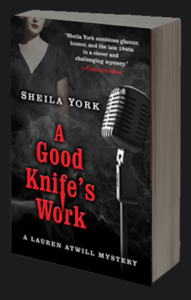
I’m headed to California tomorrow, after a wonderful night Saturday in which my creation Adam Drake came to life. Drake is the fictional private detective in the radio mystery series (Adam Drake, For Hire) that figures prominently in A Good Knife’s Work.

When I began doing research for the book, I met the members of the Cranston & Spade Theatre Company – yes, Cranston is the last name of the hero in The Shadow (Lamont Cranston) and Spade is, well, Sam Spade. The troupe performs as WWOW Radio before a live audience on the first Saturday of every month (Sept-June) at Partners & Crime bookstore in Greenwich Village. At each performance, they recreate two episodes of old-time radio mysteries.

Two actors – Alan Dolderer and Steve Viola – gave me particular help in my research, and are acknowledged in A Good Knife’s Work.  In fact, I’m pretty sure I still have a book belonging to Steve. They also became good friends. Over glasses of rye, we kicked around the idea of my writing an episode for the company, but nothing ever came of it. Until A Good Knife’s Work was on the brink of publication, and I suddenly decided it might be swell to have one of the episodes mentioned in the book turned into a show.  On page 152 of A Good Knife’s Work, my heroine, Lauren Atwill, watches a rehearsal of an episode titled A Storm of Suspects. There are only a couple of pages about the episode – a few lines of dialog, a few sound effects performed, and a drawn-from-reality cigarette commercial, in which a doctor talks about how good cigarettes are for digestion. I translated that to a script, added maybe another page of dialog. And that was all I had. It was pretty clear I didn’t know nearly enough about how to write a radio script to make it work. That’s when the company’s artistic director, Michael Johnson, stepped up and in, like, two weeks wrote a smashing script for A Storm of Suspects. (Michael was also responsible for the 1940s cocktails served at my launch party – check out the blog We Launch A Good Knife’s Work.)

Saturday night, they performed the script. In the cast: Michael, playing Adam Drake; Karla Hendrick as both Maisie Lane, Adam’s spunky new secretary, and the maid in the murder victim’s mansion; Alan Dolderer as the victim and the victim’s wastrel son; Bob Rutan as the conniving lawyer, the show’s announcer, and a beat cop; Rebecca Roe as the victim’s second (younger) wife; Steve Viola as the police lieutenant; and special guest Sheila York as the victim’s divorced (and really not happy about it) wife. Heather Edwards provided the music, and DeLisa White (check out her comedy routines on YouTube) the sound effects.

It was a terrific send-off for my trip. Learn more about the company, and become a fan on Facebook: WWOW Radio – The Cranston & Spade Theatre Company.

My first stop in California will be the West Coast Launch Party at M Is for Mystery bookstore Tuesday night in San Mateo.

Tangent: I’ve found that, lately, whenever I try to type the word Launch, it first comes out Paunch. Like my little finger is straying up the keyboard to try to tell me something. Maybe: Get Off Your Rear and Exercise More. Maybe: Eat More Vegetables, Stop Loading Up the Plate, Lay Off the Bread, Lay Off the Wine. Hard to tell. Really hope it’s not that wine thing.

Anyway…

Tuesday, March 9, 7pm
M Is For Mystery
86 East Third Avenue
San Mateo

The next day, I’m headed down to LA for the Left Coast Crime convention. The nearly first order of business will be a reunion of the Best Play committee for this year’s Edgar Awards (the Mystery Writers of America’s annual event). In the best tradition of writers, we have already scoped out the best bars in the neighborhood of the hotel. Later I’ll get together with the editor of A Good Knife’s Work, Denise Dietz whose novel Strangle a Loaf of Italian Bread is nominated for a Lefty Award as Best Humorous Mystery, and buy her a few drinks. (I think I feel my little finger straying up the keyboard again.)

I’m sticking around after the conference to do some research for the next Lauren Atwill mystery at the LA Public Library and the library of the Academy of Motion Picture Arts & Sciences – two terrific places. Pretty much all you have to do is say, “I’m looking for….” and the librarian is already handing you everything you need. Neither of my books would have been possible without them.

While I’m staying over, the folks of the Burbank Public Library have invited me to a Coffee & Conversation night with their readers:

Tuesday, March 16
Buena Vista Branch Library
300 N. Buena Vista Street
Burbank, CA
7pm

Time to wrap this up and start packing. It’s been a long time since I’ve had to pack for ten days and been expected to wear something other than tee shirts and hiking shorts. Okay, it’s been a long time since I’ve been on a ten-day hiking trip too, but that’s between me and my little finger. How many jeans? How many slacks? How many days can I get away with wearing exactly the same thing? 

Just in case I perform my usual ritual of dribbling food down my front, I’d better pack one outfit especially for my panel, Saturday afternoon at 2:30. It’s called You Go, Girl!  It’s not called You Go, Girl, and Clean Lunch Off Your Blouse.

Guests of Honor at Left Coast this year are Lee Child and Jan Burke. I haven’t seen Jan since she hosted the Awards Banquet at Malice Domestic in 2004. She was a hoot. Lee and I run into each other from time to time, as he lives in New York City and is a member of the NY regional chapter of the Mystery Writers of America, for which I serve as treasuer. 

Okay, I’m through with the name-dropping. You can see how pitiful I am at it.

Sheila: Name the famous writers you know. Name the famous writers who wouldn’t stare at you blankly when you said hello. Do you run out of fingers before those fingers can type Paunch?

Mr. Francis

Dick Francis died Sunday in the Caymans, where years ago he’d taken his English bones to warm in the sun, bones that had been broken so often in his first career as a champion steeplechase jockey. Bones so often broken that they forced him to give up riding. And find a second champion career, thriller writer.

He was one of my longtime favorite novelists, and curiously, I had spoken about him only a little over a week ago, at the Murder in the Magic City convention in Birmingham, Alabama. I was part of a panel — along with Sheila Lowe, Meredith Cole and E. Michael Terrell – that was titled Murder Gets a Hook. 

We talked about what ‘hooks’ a reader, and I shared my view that there were actually three hooks in good writing.

If you write a series, the first hook is the mix of ingredients that form your foundation — the protagonist’s occupation, the locale, mood, period, and the continuing cast of supporting characters. Second, the plot idea for each individual book. Third, the opening grab — what pulls readers into a book and makes them want to take it home.

Mr. Francis didn’t write a series, although some would argue that his heroes were often a variation on the same theme. Sid Halley appears in three novels, but Mr. Francis wrote dozens.

He excelled at the last two hooks.

He wrote intriguing plots that captivated readers who had never even seen a horse up close, let alone gone to a race, readers who weren’t British and knew nothing about bookmakers, trainers, changing rooms or club badges.

And he knew how to drop the reader immediately into a story.

His very first novel, Dead Cert, opens in the middle of a race, and no one made a race more exciting. Those descriptions would define his work. 

It was the beginning of his second novel, NERVE, that I brought with me to Birmingham to share with the panel audience. In it, he demonstrates one of his other remarkable talents: creating gripping first lines.

Art Mathews shot himself, loudly and messily, in the center of the parade ring at Dunstable races. I was standing only six feet away from him, but he did it so quickly that had it been only six inches I would not have had time to stop him.

How can you not keep reading?

It was jockey training perhaps. The keen, ingrained understanding of the importance of getting out of the gate. That above all else had to be perfect if you hoped to win. 

Dick Francis knew how to get out of the gate.

And we were privileged to be able to ride with him.

Hail the Magic City

Still On My Nightstand: The Girl With The Dragon Tattoo
(Hey, it’s a long book)

Birmingham, Alabama, didn’t exist in the Civil War. Not blessed with the broad navigable waterways that were the lifelines of ante-bellum cities, there was only farmland stretching away from the base of Red Mountain. Then the combination of the arrival of a railroad junction in 1871 and the discovery of iron ore, coal and limestone in abundance – the ingredients used to make steel – created a city whose growth was so rapid it appeared to be magic.

Now we know why they call it Murder in the Magic City.

Well, the Magic City part anyway.

Now to the Murder part.

I spent the weekend of February 5-7 in Birmingham with 16 other mystery writers for the annual fan conference known as Murder in the Magic City, sponsored by the Birmingham chapter of Sisters in Crime, Southern Sisters, and the Homewood Public Library (where the event was held).

An intimate conference, M in the MC is small enough that no fan has to choose among panels, which are presented successively in one large hall. And we writers like to think of it as guaranteeing that no one has to miss a single one of our unforgettable insights.

I joke, but there was one I found particularly intriguing. It came from S.J. Rozan, one of the two Guests of Honor – along with C.J. Box.  As part of her engaging presentation, S.J. offered her opinion about why we read mysteries – and it’s not the reason you probably think you do.

We’ve all been told over and over, so often that it’s accepted wisdom, that we read mysteries for the satisfaction of seeing order broken and then restored. Yet we read books in which justice is not served. We read books in which justice comes at too high a price. Yet we read them.

Perhaps instead, S. J. said, we read mysteries because they explain what in real life is often heart-wrenchingly inexplicable.

If your best friend steps too far into the street and is hit by a car, there is no reason for it. It’s a horrible accident. You ask why? But there is no answer to that. In a novel, the friend would have guilty knowledge or would be an unwitting witness to a whopper of a crime. In a mystery, that car was waiting for your friend. That’s the reason she died.

By the end of the book, you may not get justice, but you’d get the answer.

S. J. is right. In my humble, but perfectly correct, opinion.

Other highlights of my day:

Andrew Grant told a funny story about a relative – next time you see him, ask him about his daddy.

Off-panel, Patricia Sprinkle and I got to talk about our mutual love of Nero Wolfe. Patricia wrote an introduction to In the Best Families in an excellent edition of the Wolfe corpus published a few years ago. (Read about my love for Nero in my blog, Sheila Runs with the Pack.)

I met Joan Kennedy, who shared the story of how Birmingham got its nickname, took me to brunch and riveted me with tales of crime in the art world. She’s written a book about it. I can’t wait to see that book in print.

I met Karen Cunningham, who picked me up at the airport and was my tour guide of the sights of Birmingham while she drove me to Homewood, just south of the city and the site of the conference. As we left downtown, she pointed up to the top of Red Mountain and the statue of Vulcan, the Greek god of the forge. At 56 feet, he’s the largest cast-iron statue in the world, and sits atop a stone tower pedestal that’s another 100 feet. It’s hard to miss him. Vulcan looks down on what was farmland all those years ago, a spear held to the sky, his hammer by his side, wearing his leather apron. And nothing else. From time to time, Karen says, religious groups try to get someone to put pants on Vulcan, but nothing ever comes of it. She drove me to the mountain top, to Vulcan Park.

“If it’s one thing you have to see while you’re here,” she says, “it’s Vulcan moonin’ Homewood.”

Thanks to all the volunteers who made Murder magic, especially Margaret Fenton, who was cheered by fans and writers for two reasons this year: her organization of the event and the publication of her first mystery novel, Little Lamb Lost.

It was Magic in the city.

The moon shines bright tonight over Birmingham.

We Launch A Good Knife’s Work

On My Night Stand: The Girl with the Dragon Tattoo

Last night, we launched A Good Knife’s Work, with a huge party at Partners & Crime in New York City, one of the great mystery bookshops.

And it turned out to be an even bigger party than we had imagined. For reasons nobody could have foreseen.  

Our story begins on Sunday. I had made careful, extensive preparations for the launch party: for weeks, I had emailed and follow-up-emailed invites to friends, fans, coworkers. I’d hired a bartender, friend Michael Johnson. Because there would be limited space at the bookstore for drink mixing, Michael came out to the house on Sunday not only to mix up terrific batches of two iconic 1940s cocktails, the Manhattan and the Gimlet, but also to create a signature drink for me called A Good Knife’s Work, a fabulous red martini, which turned out to be the hit drink of the launch. Naturally, we had to sample his batches along the way, to make sure there was just the right ratio of rye to sweet vermouth (Manhattan) and lime juice to gin (Gimlet): we did not necessarily follow the advice of Terry Lennox in Raymond Chandler’s The Long Goodbye: “A real gimlet is half gin and half Rose’s Lime Juice and nothing else.” We were zealous scientists in our pursuit of perfection. Fortunately, thanks to public transit, no driving was required.

I had also acquired some top-notch barware – gorgeous stemmed unbreakable cocktail glasses that looked like they’d materialized from the 1940s. I had baked my famous (at least among my friends) deadly delicious chocolate chip cookies, and my husband, David, prepared his equally lauded appetizer of bacon-wrapped dates stuffed with almonds. When we throw a party, we throw a party.

Now, story takes a serious turn on our unsuspecting heroine.

Monday, Kiz Reeves, part owner of Partners & Crime bookstore, called to tell me – as gently as she could – that my launch was about to change, drastically. There had been a miscommunication between the bookstore and the publisher and publicity people who represented another writer, Matt Beynon Rees. Somewhere along the line, the publisher and publicity people had come to believe that February 2 had been set as the date for a signing party for Matt, but the bookstore had no record of that agreement. On Monday morning, Kiz received a call from the publisher to check that everything was ready to go and was taken by complete surprise. Nevertheless, Matt had been told weeks before by the publicity people to go ahead with his plans, and oblivious to the miscommunication, he had sent out his own invites and alerted his fans.

To call this a miscommunication is like calling the Nile a creek.

My launch party had now become a dual signing with a man I’d never met.

And who to boot wrote dark mysteries about a Palestinian detective.

We skip over the part where our heroine, accepting fate, says goodbye, hangs up the phone and then expresses her disappointment to her husband and friends for a while. Okay, maybe for hours on end.

Tuesday night. Our heroine arrives early.

I have to finish cutting and rehearsing the portion of the book I’m going to read. As we have two writers, each will get about half the normal time. And okay, I want to get the lay of the land, get my close friends into a posse and establish a little territory, girded now for the possibility that I could get elbowed aside by a well known author with a more powerful publisher.

Then Matt Rees walked in. Gracious, charming, warm, generous, friendly and funny. One minute, I’m feeling proprietary about the cocktails, and the next I’m inviting his publicity people to hit the bar.

But we still have the dual signing issue, about which most of the guests will be unaware. They continue to steam in. The room is filling up. Common ground. Where did our work have any common ground? Is there any link we can present to the crowd? My suggestion: Both our books had dark covers, both had killings done with knives, and Matt’s hair and my roots are the same color. Fortunately, Matt had a better – if less entertaining – connection: We had both been deeply influenced by Raymond Chandler. And had taken that influence in completely different directions.

Kiz made a welcoming speech to the guests, in which she announced that the only people connected to the scheduling snafu who were completely blameless were the authors. Big laugh. We begin.

And we work the crowd like we’ve known each other for years.

We sell out of books (and dozens more orders are placed with the bookstore). As a bonus, I discover a writer whose work I can’t wait to read. Matt’s first book, The Collaborator of Bethlehem, is next up on the night stand.

New definition of SNAFUs: Splendid Night and an Unqualified Success.

And thanks to photographer Mark Lentz for the terrific pictures. 

Matt Reads from The Fourth Assassin

I Take a Question from the Audience

Fans Line Up for the 1940s Cocktails

I Start to Read from A Good Knife's Work

Mr. Parker

On My Nightstand: Robert B. Parker’s God Save the Child

Robert B. Parker’s sudden death January 18 came as a shock and a reminder of how much we rely on the writers we love.

It just seemed natural to assume he would go on forever, producing Spenser novels, and Jesse Stone tales and adventures for Sunny Randall.  That would be the way of things. Great mystery writers can’t die. They can’t leave us knowing that this is all we will ever have from them.

I took out my dilapidated copy of The Godwulf Manuscript, Spenser’s first job. It’s fascinating to watch Parker find Spenser, who as the book progresses, becomes a more particular character, and less a generic wisecracker who smarts off even when it is certain to make it impossible to get the information he wants and needs. My favorite example: About three-quarters of the way through, Spenser roughs up a college student half his size and comes away with evidence and a marvelous self-loathing.

“It was raining when I came out, a cold rain about a degree above snow, and in the dark the wetness made the city look better than it was. The light diffused and reflected off things that in the daylight were dull and ugly. It was nearly eight o’clock. I hadn’t eaten since breakfast. I went to a steakhouse and ate. Halfway through my steak I caught sight of myself in the mirror behind the bar. I looked like someone who ought to eat alone.”

As you move into God Save the Child – where Spenser meets Susan Silverman – you see his wisecracking become more internal, although throughout his career, Spenser’s ‘detecting’ always seemed to be more about confronting people than actual investigation.  Not that we didn’t love that. Not to mention the careful descriptions of Spenser’s cooking (although he rarely seemed to go shopping) and, in those early books, those fabulous 1970s clothes!

There’s a wonderful quote from Harlan Coben in Parker’s The New York Times obituary: “When it comes to detective novels, 90 percent of us admit he’s an influence, and the rest of us lie about it.”

Put me in the 90%.

Are You Going to the ALA?

On My Nightstand: Peter Mayle’s The Vintage Caper

We Love Librarians.

Next weekend, January 15-19, dozens of mystery writers will descend on Boston for the American Library Association (ALA) Midwinter Meeting. If you’re a librarian and new to ALA conventions, there’s something you should know. Writers love you. They aren’t stalking you. It just feels that way when they insist on telling you – at great length – how libraries changed their young lives.

So, if you’re going to be there, I hope you’ll stop by the Sisters in Crime booth, #2022, and meet some mystery writers. We promise not to attach ourselves to your ankle.

On Sunday, the 17th, I’ll be in the booth – giving away samples of A Good Knife’s Work – from 11:15a to 12:45p. Sharing the booth during that time slot will be Vinny O’Neil, author of the Frank Cole series, whom I’ve never met. I’m looking forward to getting to know Vinny.

Yes, I know, I used “whom” back there. But librarians sometimes start off as English majors, and I want to impress.

I didn’t start off as an English major – or end up as one – but I admit to being one of those people who flinch when I see French Fry’s on the menu. Or the apostrophe going the wrong way in ’Tis the Season. It’s an apostrophe, just like the one in “don’t,” marking where something’s missing. It’s not an opening single quotation mark (‘Tis the Season). We owe the increase in the appearance of this particular error to word processing, which makes it damn hard to type an apostrophe at the beginning of a word — and consequently makes too many people think the open quote must be right — and to the decline in respect for proofreading in printed and online material. I know. I began my current day-job career as a proofreader just as the tsunami of the Internet hit. 

In my home office hangs a framed New Yorker cartoon, in which a customer seated in a restaurant is haranguing the beleaguered waiter, who is waiting for his order: “I’ll have the misspelled ‘Ceasar’ salad and the improperly hyphenated veal osso-buco.” When I first saw that cartoon, I laughed out loud. I had to have it. I bought it, and proudly hung it on the wall of my day-job office. That first day, a coworker came in, saw it, and said, “Oh, Sheila, that’s wonderful. It’s just like you.”

It’s now hanging at home.

In my defense, I have never once in my life blamed a waiter for the menu.

Quirk No. 1, however, has now been revealed. I’m a grammar junkie. 

Hope to see you in Boston.

Sheila Runs With The Pack

On My Nightstand: Rex Stout’s The Silent Speaker

I knocked myself around for a while, thinking about what my first blog should be about. An introduction to me? Boring. Views on writing? Way too presumptuous and pretentious for a first blog.  Then I decided: Just jump in. Write about something that happened recently that you really enjoyed.

Okay. Here goes.

On Saturday, December 6, I had the great pleasure and honor of offering a toast at the annual Wolfe Pack holiday banquet in New York City, and not only meeting two entertainment legends but also sharing a lectern with one of them.

The Wolfe Pack is the international Nero Wolfe fan club, which each December throws a holiday banquet and invites a special guest speaker. At some point during the year, the Pack had discovered that Elaine May — the sensational quadruple-threat director, writer, actress, comedian — was a Nero Wolfe fan.

So they thought, what the heck, let’s invite her. She can only say no. But she said yes, sure, why not?

And as her guest, she brought Stanley Donen, legendary director of movies such as Singing in the Rain and Charade (one of my all time favorites and a terrific mystery)!

Their agreeing to attend was kept secret by the steering committee until the night of the event, so the rest of us knew only that a special speaker was coming. When they appeared, I was speechless. Which you will realize as you get to know me better is a difficult state to achieve. And not a particularly good thing in this case, as I was supposed to speak as well.

Miss May offered a warm, funny and poignant remembrance of her attempt in the early 1970s to make a Nero Wolfe movie, starring Orson Welles. When she said the name, the banquet guests as one breathed a long sigh for the absolute perfection of that casting. She told of meetings with him, of his charm, his warmth, and of course, his outsized talent. But as Miss May noted, two weeks means two years in Hollywood, and before the other participants in the project could be aligned to agree on a suitable Archie Goodwin, Mr. Welles died.

And I got to share a lectern with her. Well, touch the same one anyway. How did this happen? Let me digress for a moment. Please note, this will be a continuing theme of my blogs. Oh, look, there’s a tangent. Think I’ll go off on it.

Back in September, Jane K. Cleland, the author of the wonderful Josie Prescott Antiques Mystery series and a devoted fan of the Nero Wolfe books — or the corpus, as members of the Wolfe Pack call them — had asked me if I would be interested in offering a toast at the Pack’s banquet at Bouchercon. Bouchercon is an annual mystery fans/writers convention, held every October, and in 2009, in Indianapolis. Rex Stout, author of the Wolfe novels, was born in Indiana (in Noblesville), and in recognition of that, the Wolfe Pack decided to hold a banquet at Bouchercon and invite some of Stout’s relatives who still lived in the area. At all Wolfe Pack banquets, it’s tradition to offer toasts — to Stout, to Wolfe, to Archie, to Felix and to an Other, a character of the toaster’s choosing.  Jane knew I was a new fan of the Wolfe novels — as well she should, since she and fellow Pack member Carol Novak had introduced me to them.  Did I want to offer one of the toasts, she asked? Which one? Nero Wolfe. I took a big gulp and swallowed my first instinct, which was, I can’t do that. I’m brand new.

Let me say right here I’m not afraid of performing. Put me anywhere near a spotlight or a microphone, and I’m one happy girl. But that’s only if I have a script. I would have to write this toast. What would I say that could possibly stand up to the observations that would be offered by the other, super-dedicated, far-more-experienced fans?

But it was such an opportunity. I’d be appearing in front of a hundred conference attendees — fans and fellow writers. As they say, couldn’t hurt. Unless, I totally humiliated myself. As I didn’t have the breadth of knowledge other members did, I went for laughs. My toast would be about how I ended up falling madly in love at (ahem) a certain age with the rudest and most misogynist hero in mystery fiction.

The toast was so successful the Pack steering committee asked me to reprise it at the holiday banquet.

So I waited for the New York stage to invite disaster.

I arrived early at the venue, the Jolly Hotel. I’m not making that name up. Its full name is Jolly Hotel Madison Towers, and it’s pretty swank, but the name…  Well, let’s move on. No tangents right now.

From time to time during the cocktail hour, I ducked into one of the swank corridors and practiced my toast. I don’t wing it. I prepare. And I was doubly nervous by now, as I knew the identity of our mystery guest and her guest.

Finally, somewhere after the first course, I was introduced by Ira Matetsky, the Werowance, which is Algonquian for tribal chief. (These Packers are serious.)

I stood up, confidently strolled to the lectern, took a breath and began.

“I’d like to thank the Wolfe Pack for inviting me to offer this toast tonight. I am truly humbled by…”

Then I made the mistake of glancing to the table on my right, and there were Miss May and Mr. Donen. Looking at me. And the words went right out of my head.

I’d had the foresight to bring a copy of the toast to the lectern, but by now — even though only a few seconds had passed — it was clear to everyone that something was wrong. Fortunately, my stage training kicked in. I lowered my head, cleared my throat, swallowed, then raised my chin, adjusted the mike, and said, “Pardon me, something caught in my throat. I think I choked on that attempt at humility.”

The lovely audience, well supplied with wine and good manners, laughed. I went on. And they kept laughing.

And Rebecca Stout Bradbury, one of Rex Stout’s daughters, asked for a copy of the toast.

It doesn’t get much better than that.

I would like to — humbly — thank the Pack for a wonderful night.

I Toast Nero